

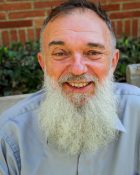
Calvin Normore

Ally Peabody
Calvin Normore, professor at UCLA since 1996, has just been named the first Brian P. Copenhaver Professor. His research focuses on medieval and early modern philosophy, the history of logic, and political philosophy, and he is currently working on a book manuscript entitled Descartes’ Ontology of Everyday Life, co-authored with Deborah Brown. He was interviewed by Ally Peabody. Ally is a second-year student in the Department of Philosophy. She is particularly interested in ethical, meta-ethical, and ontological questions involving moral standing.
AP: What brought you to philosophy and what made you want to become a professional philosopher?
I grew up in a small town in Newfoundland, but it was the biggest town for a good distance around. There were no bookstores, but there were two drugstores that had little revolving racks of books and there was a public library. I was going to a Roman Catholic high school so I knew there was such a thing as philosophy from school. In the drugstores I found two books, one was Jacques Maritain’s A Preface to Metaphysics and the other was a collection of selections from Aristotle. I brought them home, and I didn’t understand either of them but I could tell that these were heavy-duty stuff on first reading. At the public library I found a couple of things of Bertrand Russell’s including his Why I’m Not a Christian and parts of his autobiography, and I read those and I decided “OK, I want to be Bertrand Russell.” And so I set out to be Bertrand Russell. When I went up to university I wanted to do math and philosophy. But I had the following relationship to math: I liked having done it but I didn’t actually like doing it that much. Whereas the philosophy I liked actually doing, so I moved more over into philosophy. But I didn’t intend to become a pro at all. I think the thought never crossed my mind in those days. Even when I was in graduate school, for a lot of my fellow graduate students at that time, being an academic wasn’t what they wanted to do particularly. So that all came much later, by accident again.